Document Security Software: Secure documents, control & track use
Protect IP
Effective document protection no matter where they reside:
Stop unauthorized access
Stop sharing and distribution
Strong US Gov strength encryption, DRM, and licensing controls
Restrict Use
Control how documents are used:
Stop editing, copying and screen grabs
Stop printing or control the number of prints
Lock use to devices and locations
Set Expiry
Set documents to automatically expire:
on a fixed date
after a number of days use
after a number of views and/or prints
Revoke Access
Revoke access regardless of where documents are located:
revoke a document for all users instantly
revoke individual user access to single, multiple, or all documents
revoke access automatically after a number of views and/or prints
Watermark
Add dynamic watermarks to viewed and or printed pages. Dynamic variables (date/time, user name, company name, email address) are replaced with actual user and system data when the protected PDF document is displayed and/or printed.
You only have to protect a document once in order to customize it for multiple users.
Log Use
See how your documents are being used:
track and log document views
track and log document prints
see what devices & operating systems users are using
Comply Law
Comply with legislation by controlling access and use:
Ensure only authorized parties can view confidential documents
Document security management and protection systems
What is document security?
Electronic document security is a catch-all term that refers to the protection of information in text-based files. Document protection for digital documents can include methods to prevent unauthorized viewing, printing, copying, editing, and screen grabbing, as well as measures to prevent counterfeiting or alteration, such as watermarking.
Organizations’ requirements for document security can differ greatly, as can what they are setting out to achieve with it. Here we will look at the three principal approaches used today (encryption, DRM, and collaboration), how they rely upon each other, and where they differ.
Why is electronic document security important?
Year after year, businesses produce massive volumes of data. Much of that data is sensitive. Sensitive documents containing PII, draft contracts, HR data, financial reports, intellectual property, and more are exchanged between departments and shared with external stakeholders.
Document security ensures that sensitive documents are treated with a level of caution that befits the information they contain. It allows organizations to prevent interception, leaks, unauthorized access, and misuse. In turn, this helps to protect organizations against events that can impact their client relations, revenue, or stock price, such as IP theft, negative press, and legal challenges.
What are the types of document security?
Encryption
Underpinning all document security systems is encryption. If your document security system does not use this, then forget it – it’s just smoke and mirrors. Encryption is the technology that hides documents from those who are not authorized and verifies that the content the originator created is unchanged.
If you are an authorized recipient of encrypted information, you can do anything you like with that information once you have removed the encryption. That is the Achilles’ heel. The recipient of documents that have been decrypted can go on to use them in any way they wish, and to alter them in any way they wish. That does not mean they can pretend that someone else created them, which is a valuable protection, provided you can be bothered to look closely at the authenticity of the documents you receive. But judging by the number of people taken in by fake messages from financial institutions or amazing offers from Nigeria, maybe looking to see if a document is real is not a top priority.
Encryption, therefore, is just the building block of document security and is of limited use after the document reaches its intended recipient.
DRM – Digital Rights Management
DRM looks to take care of continuing control(s) over information. Whether it’s a song, film, or book, DRM uses and then goes beyond the capabilities of pure encryption by enforcing persistent controls over the ability to use the content. It is used to limit the ability to distribute (Copyright being the right to make copies and distribute) print, or view.
Historically, DRM has been used when one entity wants to grant access to its information to another entity, but under controlled conditions. This can be for making sure employees cannot take key documents containing sensitive information with them if they leave, or that those who have bought a book, or a training course, cannot pass it on to anyone else without the publisher’s permission (and, no doubt, a fee).
The combination of digital rights management controls and encryption ensure documents cannot be shared with others, copied, modified, or printed. The use of copy and paste and screen grabbing is usually prevented (depending on the vendor). Also, some DRM systems enable you to lock document use to specific locations (say an office in the US). This can be an important security feature if you want to prevent mobile device users from using documents in insecure or unauthorized locations.
If you are looking for complete control over your document security, then a solution that uses digital rights management is what you need to purchase.
Collaboration
Collaboration is an important aspect of the document workflow where document modification is required. Often, it does not make use of encryption technology for security, instead relying on access control mechanisms to identify who authorized users are and to link those identities to the input they made on a specific document.
As you can guess, collaboration is really a precursor activity to DRM. The controls for collaboration are focused on making sure corporate administrators can be certain that only authorized persons had access to and could (or did) amend the document, and that it is properly authorized for distribution. The document that is distributed will appear to be a finished item, and nothing surrounding internal management will be made available to anyone, either internally or externally. The ability to prevent the use of simple cut and paste or stop screen grabbing by third-party screen grabbers is usually not implemented.
Collaboration tools require both ends to use the same software (and often the same version) so each party you need to communicate with must have the same infrastructure, or use a browser based system such as Google Docs. If you think that Google Docs Security will be adequate for your business then see How secure is Google Docs for document protection?
“Safeguard is a cost-effective document security product that provides high security for our lesson plan books preventing them from being distributed and used without our knowledge.”
There have been significant shifts in file protection systems over the past few years, marked by changes in focus, the introduction of new feature sets, and evolving regulations. It can prove difficult to sort genuine improvements from pure hype, so we’ll cover a few of them here:
AI-powered document security
AI has proven to be a double-edged sword when it comes to document security. On the one hand, some cloud document providers have introduced machine learning algorithms to detect suspicious activity and misuse. This offers some (primarily workflow) improvements over traditional monitoring and document access control. On the other hand, businesses now have another major risk: sensitive data leaked via AI tools. A recent study found that almost one in ten AI prompts in business disclose potentially sensitive data.
Dynamic watermarking
More businesses are realising the benefits of dynamic watermark solutions, with the functionality introduced in Word, Excel, and PowerPoint via Microsoft IRM. Such functionality dissuades the sharing of sensitive information by automatically inserting a user’s name or email address into a watermark when a document is opened.
Dynamic watermarks are an excellent innovation, but many forget that they are of little use without well-implemented digital rights management controls. Researchers have found ways to remove Microsoft IRM protection and have freely shared tools that enable others to do the same.
Blockchain document security:
Rather than using digital certificates, various document security providers are moving to the blockchain. The document is hashed with a cryptographic algorithm, with the hash stored on the blockchain along with the document’s metadata or issuer ID. In the future, users can rehash the document to check whether it matches the one stored on the blockchain, verifying that it is unaltered and authentic.
Though there are many snake-oil solutions surrounding the blockchain, document verification isn’t one of them. It’s a genuinely useful tool, provided you understand what it is and is not for. Blockchain document security does not prevent users from editing, sharing, or viewing a file, nor does it encrypt documents by itself. There is also no way to prevent somebody from uploading fake documents from being hashed and uploaded. Just like PDF certificates, it is simply a mechanism to verify whether you have a legitimate, unaltered version of a document.
Self-destructing documents:
Several major cloud document providers have now introduced expiry controls to their documents. Self-destructing a document after a particular date or number of days since first open is good practice for security and compliance. Much like dynamic watermarks, though, the effectiveness hinges on how well you can enforce anti-copying, downloading, printing, and sharing controls. Cloud document controls are easy to bypass, so expiry mechanism on such services cannot be trusted. Instead, businesses should look at desktop DRM solutions, which have had effective expiry for decades.
“Quantum-ready” encryption:
As we move closer and closer to Q-Day, various services and businesses have begun to adopt quantum-resistant cryptography. Though several new quantum encryption protocols have been created, most are simply transitioning to AES 256. With its large key size, AES 256 is already resistant to an attack by a quantum computer.
Making Document Security work for your organization
What can a document security solution do for you?
The important question in document security is, “What are you trying to achieve?”
If you are just sending confidential documents or sensitive data from point to point and are confident that the recipient will not share these with others, then pure encryption is the right tool for you.
If you need to allow document modification and track who has created/amended/authorized the content of a document, then a collaboration tool is almost essential. However, you will have to come to terms with the fact that you cannot fully prevent leaks during this process.
If you want to manage the ongoing use of document content and prevent digital documents from being shared with others, you need a DRM solution. Only DRM solutions provide the controls to ensure your documents cannot be misused by staff or customers.
You need to be clear about your objectives for securing documents; otherwise, you may end up with the wrong kind of document security solution and a wasted investment.
What are the best practices for document security?
A good place to start when deciding the type of protection you need is defining a clear set of best practices that your organization should adhere to. It’s essential to be specific, as each organization has distinct needs and handles various types and volumes of data. However, some general elements to keep in mind include:
Classify documents appropriately: This is a mandatory first step. You need to define what constitutes sensitive information and ideally categorize it (e.g. public, internal, confidential, highly sensitive). This will help to ensure that sensitive information receives appropriate security while users of non-sensitive documents aren’t bogged down by restrictive controls.
Control access: Ensure that users can only access documents for which they are authorized and that files remain unreadable to unauthorized parties. If you’re using a cloud service, the best you will be able to do are measures such as MFA and A good DRM solution will lock document access to only the devices of authorized users.
Encrypt in transit and at rest: Part of controlling access is ensuring that documents are encrypted while they’re traveling over the internet or stored. Requiring an encryption key to access a document provides another layer of security should an attacker intercept a document or compromise a device. Be wary, however, of password-based document encryption. Passwords are much easier to crack, guess, or share with others than a long, random encryption key.
Prevent copying and sharing: Use DRM controls if possible to prevent the creation and sharing of unprotected copies of sensitive documents. Controlling access is of limited use if an authorized user can download your document and share it with whomever they like (including on the open web).
Monitor document usage: Monitoring how often documents are opened, by whom, and from where can help you spot suspicious behavior and act before a major incident occurs. Further, it lets you determine when a document is no longer in active use so that you can take it out of circulation.
Securely digitize paper documents: Creating digital, DRM-protected copies of physical documents typically provides better visibility and control while reducing the chance of loss. You can see who is accessing a document, when, and where from, while ensuring that users cannot distribute photocopies by disabling printing.
Train employees: The best document security in the world is useless if relevant parties are not trained to use it effectively. Make sure users are aware of the principle of privilege, secure sharing procedures, sensitivity levels, network security, incident reporting, etc.
Back up regularly: As the world found out in 2017, ransomware is a major threat to operations. While such an attack will almost always have a financial and operational impact, regular (encrypted) multi-location backups of key documents limits the damage.
Audit regularly: Finally, do not “set and forget”. Long-term document security requires long-term attention. Get a third-party to assess your policies, software solutions, and training to make sure you’re adequately protected against the latest threats and developments.
Why Locklizard for Document Protection?
Document security systems & protection software
Safeguard PDF Security is a document security software for PDF files. It provides effective document access control, allowing you to manage who can use them, how for, where, and when. With Safeguard PDF security, you can stop or limit printing, expire and revoke documents at any stage, stop screen grabbing, and watermark documents with dynamic data to identify users. Documents are locked to authorized devices and are only ever decrypted in memory, so there are no unprotected files that users can distribute. You can securely share or sell documents and control their use regardless of their location.
Safeguard PDF Security is document security software for PDF files. You control who can access your documents, how long they can be used, where they can be used, and when. With Safeguard PDF security, you can stop or limit printing, expire and revoke documents at any stage, stop screen grabbing, and watermark documents with dynamic data to identify users. Documents are locked to authorized devices and are only ever decrypted in memory, so there are no unprotected files that users can distribute. You can securely share or sell documents and control their use regardless of their location.
Safeguard Enterprise is document protection for larger businesses and organizations. It has all the document access control and rights management features of Safeguard, plus some additional functionality. With Enterprise Rights Management, you can track document use, lock user document access and use to specific countries and IP addresses (i.e. only an office location in the US), control sub-administrator access, flexibly check and transfer licenses, and create reports.
With both our document security systems, users view your secure documents using our FREE secure document viewers. Users can either install a viewer or view secure documents in their browser or from a USB stick with our zero-installation solutions.
How to Secure Documents with Safeguard Document Security
How to protect documents securely
To secure documents with Safeguard DRM, select your PDF(s), then choose the document security controls you want to apply in Safeguard Secure PDF Writer:
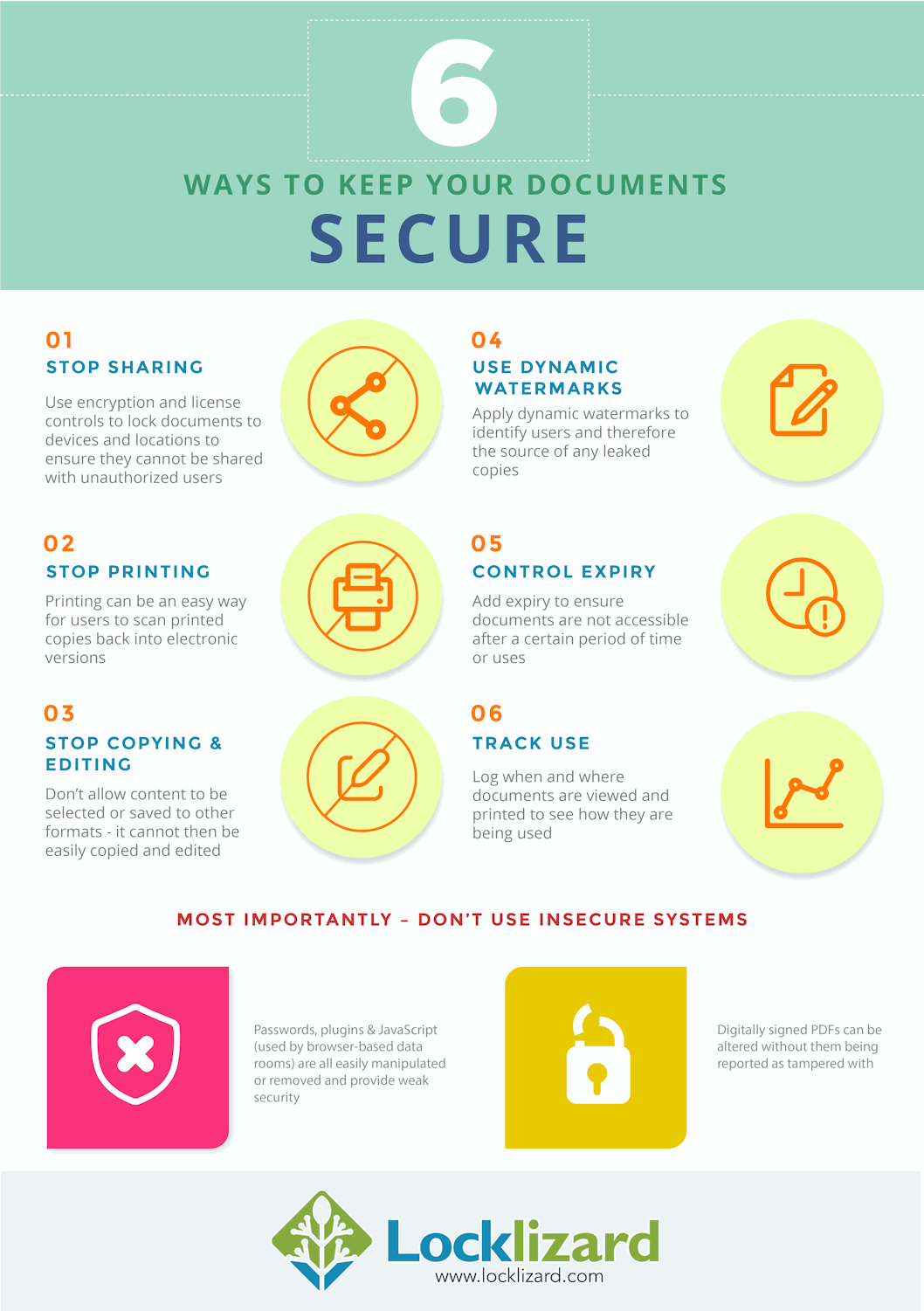
Stop printing, allow printing, or limit the number of prints.
Add dynamic watermarks to viewed and or printed pages. Dynamic variables replace actual user and system data when the document is viewed/printed so you only have to protect the document once for all users.
Make the PDF expire on a fixed date, after a number of views, after a number of prints, or after a number of days from opening.
Secure documents against screen grabbing (even from remote connections) applications and stop the use of Windows printscreen.
Track document views and prints.
Safeguard’s default document security
Stops users from editing, copying, and pasting content
Locks PDF files to devices so they cannot be shared
There are no passwords for users to enter, manage, or remove
Revoke documents at any time regardless of their location
Secure Documents without Passwords
Locklizard takes your document security seriously. We provide total document protection with US Gov strength AES encryption and public key technology to ensure your important documents and sensitive information remains secure regardless of location.
Our DRM controls persistently protect your documents and enable you to revoke documents at any time regardless of where they are.
Unlike password-based document security systems, no keys are exposed to users or interfaces, and documents are only ever decrypted in memory – see our DRM technology.
Our easy-to-use administration system provides simple user and document management and unlike passwords, keys are transparently and securely managed for you.
See our customer testimonials or read our case studies to see why thousands of organizations use Locklizard to securely share and sell their documents.
FAQs
How do I send documents securely via email/Gmail?
Both encryption and a DRM solution will work for this purpose, though only the latter will maintain protection after the document has reached and been decrypted by its recipient. As encryption alone is not able to enforce editing, printing, or copying controls, you need to pair it with DRM if you want to stop sharing by authorized users.
If you’re using Gmail, don’t be tricked by the service’s ‘Confidential mode’. Confidential mode is very misleading – it is not suitable protection for confidential documents or sensitive information, as all somebody needs to do to save and share an email is right-click the page and press ‘Save as’ or open it in a third-party email client. It also doesn’t protect any attachments beyond adding an expiry date, which is pretty useless when the attachments can be downloaded and copied before that point. See how secure is Gmail confidential mode.
How should I secure documents on my computer?
If you aren’t planning on sharing them, encryption is probably the best solution, as it’s simple and free. Just bear in mind if using password-based encryption that it is only as secure as the password used – so choose a strong password.
For documents on your computer that others will be using or that you intend to share by other means, you’re better off with a PDF DRM solution. This will ensure that the document can only be used on authorized devices and that users can’t print, screengrab, edit, or otherwise copy your document content.
How do I secure a Word document from editing?
One thing is for sure – don’t use Word’s in-built read-only or “password to modify” options. As Microsoft itself admits, these are trivial to bypass and are only intended to stop accidental editing. See why you should not password protect a Word doc.
A better idea is to save the Microsoft Word document as a PDF and protect it with a PDF DRM solution such as Locklizard.
It is basically impossible to track down every instance of a document and delete it. Instead, you should be looking at disposing of documents by simply revoking the ability to view (decrypt) them after a certain date. As long as you can ensure that no unencrypted copies of the document were made before its revocation (through the use of DRM), then the document will cease to exist in a useful form.
Is watermarking a form of document security?
Watermarking isn’t typically considered a form of document security in itself, but it can act as a strong deterrent if it is implemented in the right way alongside digital rights management controls. Locklizard allows you to add dynamic watermarks to a document that insert the reader’s name and other details at view/print time. Because its DRM controls mean that watermarks cannot be removed, this stops users from sharing, as any leaks can be easily traced back to them.
Does Locklizard document protection prevent breaches of sensitive information?
Yes, using Locklizard is an effective way to help prevent a security breach or data breach. Protected documents are encrypted to prevent unauthorized access and document use is tightly controlled so that authorized users cannot leak sensitive information.
Note that Locklizard only protect PDF files so you should still adhere to best practices for protecting other sensitive data, and look to employ other security methods such as DLP systems and firewalls to prevent hacker and cyberattacks.
Does Locklizard use password protection to protect documents?
No. There are no passwords for users to enter, remove or share. If you want to protect confidential and important documents then we do not recommend any form of password protection even if combined with other security measures such as 2FA. This is because they are often easy to remove and share with others.
What encryption algorithm does Locklizard use for securing documents? Is it quantum-resistant?
We encrypt documents with AES 256-bit encryption, which is considered quantum-resistant. Encryption and decryption keys are securely and transparently managed.
Customer Testimonials
We needed to deliver e-book versions of our handbooks while not compromising on security and digital rights. Safeguard PDF security is easy to use and intuitive.
The implementation was painless and we now have a greener, more secure way of distributing training manuals.
Locklizard’s PDF protection is exactly as described – the features are highly effective and I would give it 5 stars.
I would recommend Locklizard to others - their security is simple to use and fit for purpose. It meets common needs of businesses who have information they want to protect.
We would be happy to recommend Locklizard to any company needing a flexible way to secure PDF files.
Safeguard PDF Security has provided us with a very workable solution for sharing of information in a secure fashion. The support has been excellent and very accommodating.
We can cut accounts for a user five minutes before his class starts and he is ready to go. Happy smiling customer, while we still have security and personalized watermarking.
I have immense respect for the product and Locklizard provide great customer satisfaction and service.
We would recommend Safeguard to other companies for its security, cost and ease of use. It does what we expected it to do and more.
Ease of use is a bonus and the implementation was very easy. The product manual is excellent and Locklizard staff are very accommodating.
We sell a highly valued educational product in an open and competitive market so it was important to ensure we had effective security to protect our digital rights.
We highly recommend Locklizard - a professional company with a competitive and professional PDF Security product.
We would absolutely recommend both Locklizard as a company, and Safeguard PDF Security. It has transformed our study materials to the next level.
Not only did this increase sales, but we also believe that it has increased our customers’ ability to learn, which is even more important!
We would recommend Locklizard Safeguard to other companies that need to protect PDF reports. Customers have found the process of accessing the protected documents to be seamless.
Implementation was easy and technical support has been very responsive to requests for help.
Our company would without reservation recommend Locklizard. Their document DRM software opens up delivery of our new products in a timely fashion while knowing that the content will remain secure.
The return on investment to our company has been immediately evident.
We use Safeguard to make sure that documents cannot be opened outside our local network or from a unauthorized computer in order to copy or print the documents.
It is the most feature rich, affordable, & simple to use PDF security product on the market.
Safeguard PDF Security is simple to administer and meets our needs, consistently delivering secured manuals to our customers with ease.
Return on investment has been elimination of many man hours, printing resources and postage – it is estimated that costs decreased by 50% or more.
We would really recommend Safeguard PDF Security to every publishing company for managing ePubs or e-books securely. It is easy to secure PDF files and simple to distribute them to our authorized customers only.
Locklizard also provides a good customer support experience.
The ROI for us is incalculable. We have the security of knowing that our proprietary documents are secure. This is the entire value of our company.
I would most certainly recommend your PDF security product and already have. The ease of implementation was surprising.
We can now sell our manuals without the need to print them first, saving time, money and helping safeguard the environment.
We would recommend Safeguard PDF DRM – it is the perfect solution to sell and send e-documents securely whilst making sure someone cannot copy them.
We would recommend Locklizard to other companies without hesitation.
Their PDF DRM products provide a manageable, cost effective way to protect intellectual investment and they are always looking for ways to improve them. Moreover, their staff provide an excellent level of support.



 Free Trial & Demo
 Document security management and protection systems






 How to Secure Documents with Safeguard Document Security

 FAQs
FAQs